Monday, 4 February 2013

White Like Me
(2004)

80%


Insightful-because-anecdotal look into contemporary White supremacy - written by a White.

Although author Tim Wise lacks first-hand experience of most racist practice (which he admits), he understands that White racism can cripple Whites into never becoming fully human - his basic thesis. He also recognizes - this time from the personal experience of being castigated as a “race traitor” - that a White stepping outside of the preordained attitudes of his culture invites malice from his fellow-Whites for giving the game away.

Moreover, the perspicacity of Wise also reveals White anti-racism and political correctness as largely frauds designed to fool Blacks into believing White racism is caused by Blacks rather than by Whites. (White anti-racism is done for Blacks [or to them] rather than with them because of the implicit belief that Blacks cannot stand on their own two feet, otherwise, and so anti-racist Whites are seeking a gratitude they are not owed.)

This clever book understands the full complexity of the system of institutional racism within which we are all enmeshed in the Western world, yet only posits solutions based on goodwill. Because racism is itself not a function of goodwill these solutions are hardly likely to work since they require Whites to renounce unearned privileges and cut the throat of the goose laying them golden eggs. Because this is rather unlikely, any sincere rapprochement between the two cultures of White and non-White is extremely unlikely. This is why personal friendships between peoples with differing privileges are so fraught because no matter how much a White likes a Black, the White can always turn away from the friendship if they find that the enhanced ability to enjoy the material privileges of living in Western civilization are more to their liking than friendship. (This issue has much in common with other areas of unearned - allegedly genetic - privilege such as social class and gender.)

That a White has the courage to face these issues is little short of a miracle since White supremacy relies fundamentally upon the twin-track policy of denial combined with blaming Blacks for their comparatively-poorer economic situation; ie, collaboration with White supremacy. The most important issue for Whites in dealing with their racism is that of guilt and shame - which emotionally cripples most into inactivity and into accepting a status quo that materially benefits them to the disadvantage of others.

Thus, Whites are trapped within an economic system that denies them self-knowledge, since they can only think about themselves comparatively. They can never know if they are any good at anything because they have been given automatic birthrights against which they cannot test themselves, objectively. Employed Whites can never know for sure if the job they do is because of their skills, abilities and experience or simply because of their skin color. This lack of genuine self-knowledge inhibits personal growth and makes White culture quintessentially immature and ultimately self-destructive.

The point of this book here is that by renouncing the benefits of their racism, Whites will lose their racist privileges and gain a healthy self-respect; while also renouncing the guilt and shame of their unearned position: The same as a recidivist redeeming himself and deciding to go straight.

The author also raises the question of the fact that White self-proclaimed anti-racists are often the biggest racists because of this denial-of-reality. Dealing with issues of employment housing, education and crime, the author shows that White racism is a tax on Blacks and a subsidy for Whites, that ultimately destroys both since Whites become complacent and lazy about the fate of their culture because they assume an allegedly-superior culture cannot fail. Because all Whites benefit from racism, it is hypocritical for any White to loudly-proclaim their abhorrence of it while never renouncing its benefits

For Blacks, books like this can be dull reading since the book contains self-evident truisms that Whites find difficult to face about themselves, yet which Blacks experience continuously. This makes the book longwinded when it should be to-the-point, as only a book written by someone trying to face the truth about himself can be.

White Like Me contains much educated guesswork that never, however, properly considers whether racist Whites can stand on their own two feet without the psychological prop of racism. Wise does not show how this desire for superiority can be effectively renounced. In this, Wise tacitly compares White racists with nicotine or alcohol addicts failing to repudiate their suicidal temperaments because they have nothing else to replace them with. Wise recognizes that White racists desperately try to avoid the inevitable changes in White culture that would be brought about by such changes, because those individuals possess few underpinnings in reality. An obsession with false imperial pride - past and present - based on myths of progress, civilization, liberalism, education & enlightenment now sound like the shrill and hollow delusions they always were.

It is here that the book spoils itself by being angry (rather than suitably tendentious) at the systemic nature of White racism that makes it appear difficult to remove - like a red wine stain from a white blouse - both from others and, most especially, from oneself. Are we all recovering racists, perhaps? Yet, misplaced anger cannot adequately deal with the psychological challenges presented by such racism. Yet this book’s great value lies in its not being a guilt-trip for the author nor an example of whining self-pity that almost all writing about White racism by Whites is.

This is a much-needed book since Whites are more likely to read it when they would ignore the same topic discussed by a Black. Black authors like Frantz FANON, Malcolm X and James BALDWIN are rarely-stocked by predominantly-White libraries, even though their insights into White racism are far profounder than those of Wise. Thus, Blacks will find little here to surprise them about endemic Western racism since it is merely preaching-to-the-converted. However, Wise does honestly deal with his own inevitable “race treason” and, in so doing, implies Whites would denounce a Black author with a similar point-of-view as “playing the race card”, which they could not do to a White author. Thus, paradoxically, Wise fully exploits the racial privilege this affords him to criticize that very racial privilege.

Tim Wise admits he is a not a great writer - and he certainly is not. Nevertheless, his conversational tone and his solid reasoning get him through unmasking the fact that racism is the Whites’ heart of darkness. Would it take, for example, a book written by a man about women to convince sexists to stop being misogynists? Or, can only women write such books?

That racism is a leading pathology in White culture is well-expressed and noted for its honesty. Such a cultureless culture cannot face its past and has no future unless it does so: A culture defined by its negation of others, superficially judged by externals (not inherent) attributes. To define yourself by what you are not is cultural genocide; tempting Whites to fill the cultural void with positive discrimination for themselves - negative for others - that they have come to depend on like a junkie seeking a heroin fix.

A book to help a Martian understand the nature of Whites.


Copyright © 2013 Frank TALKER. Permission granted to reproduce and distribute it in any format; provided that mention of the author’s Weblog (http://protectingthehated.blogspot.com/) is included: E-mail notification requested. All other rights reserved.

WHITE LIES:
Race and the Myths of Whiteness
(2000)

RATING:80%
FORMAT:Book


An amusingly anecdotal treatment of White supremacy from a White supremacist struggling - Racists Anonymous-like - with the twin poles of a contradiction: Loyalty to Justice or loyalty to irrationality. That such a group as RA does not exist proves the thesis of this work: That White culture is endemically supremacist and that all Whites are born with unearned privileges that few - if any - ever renounce. The price of this for Whites is shame and guilt coupled with murderous anger when the affirmative action that is racism is revealed as being such.

An easy-to-read journey through one White man’s experience of his own geneticist angst and his realization that Whites have no culture other than one defined by what it is not. Although the book itself is part of the wider struggle to free Blacks from the shackles of a hateful White culture it offers few solutions that would help Whites to stop thinking of themselves as Whites and transcend their own narcissistic obsession with the view that skin pigmentation determines character.

The book implicitly and consistently makes the point that phenotypism is solely a problem for Whites - as pedophilia is only a problem for the pedophile; rape only a problem for the rapist - and that blaming the victim is how Whites deal with their problems when their guilt, anger and shame become too much to bear.

Where the book goes wrong is in assuming that Whites are unaware or unconscious of the material benefits of White racism - they know very well; hence, their continual angry attempts at denial to hide the shame and the guilt of their unearned benefits. That Whites do not have to live their lives without worrying about the color of their skin does not mean that they are not keenly aware of its value in a White supremacist culture like that of the West.

Despite continually claiming - throughout - that this is a book about white denial the denial is present here also. That there is no such thing as unconscious White racism is obvious from the numerous examples cited here and yet the author still uses the term “unconscious White racism” to justify his own. A clever yet simultaneously sad commentary on the state of White academia in the United States.


Copyright © 2013 Frank TALKER. Permission granted to reproduce and distribute it in any format; provided that mention of the author’s Weblog (http://protectingthehated.blogspot.com/) is included: E-mail notification requested. All other rights reserved.

Tuesday, 29 January 2013

Black Jacobins
(1938)

RATING:100%
FORMAT:Book


A fantastic and superbly-written book about the only successful slave revolt in history that shows just what Blacks can do given the right circumstances and leadership.

This book that gets right to the heart of why Whites approved of African slavery for 500 years. Without the guilt and shame of a typical White historian this is an eidetic view of the challenges posed by White supremacy - then and now; exposing the real reasons for the abolition of racial slavery: Free trade is more profitable than mercantilism since one can then sell to the highest bidder and not just ones own government. As well as the fact the British government’s jealousy of the French making more money than they at the traffic in human misery that the possession of India meant the British need no longer indulge in.

Humanitarianism is absent from this account since a humanitarian country would obviously never have become involved in racial slavery in the first place. The book then comes to the obvious conclusion that White history books simply lie about the ethical role of Whites in the emancipation of African slaves.

What makes this book so readable is the precision with which the writer effectively skewers White politics as quintessentially White supremacist with humor, wit and irony.

The mixture of fear and envy Whites have for the exotic is stressed here through their repeated claim that anything foreign is inferior while being embraced to fund the English (17th century) and French (18th century) revolutions. A supreme irony of history is that both these bids for freedom and statements of the inalienable rights of Man were made possible by a bourgeoisie made rich from African slavery. The moral contradictions of White culture today stem from such institutions as the writer here makes many links between the past and the present.

That the abolition of the slave trade and of slavery itself never simultaneously abolished the various European empires and the White racism that drove them on is a telling legacy that remains with us to this very day.


Copyright © 2013 Frank TALKER. Permission granted to reproduce and distribute it in any format; provided that mention of the author’s Weblog (http://protectingthehated.blogspot.com/) is included: E-mail notification requested. All other rights reserved.

Ancient Egyptians for Dummies
(2007)

RATING:40%
FORMAT:Book


Apart from not explaining where the culture and civilization of ancient Egypt came from in Africa; that is, what pre-existing people it resembled, this book fails to get much beyond the White Western historical perspective of its author.

Ancient Egypt is presented as an African miracle; almost spontaneously sprouting as the world’s alleged first civilization. Western Egyptologists have a problem placing ancient Egypt firmly within the context of what came before despite the existence of similar civilizations further south that predated it. One can only suspect the racism of White Egyptologists unwilling to admit any Black undertaking to be worthwhile.

Worse than this, the book is written to interest modern Western readers in the practices of an ancient culture by comparing and contrasting them with us. This leads us to assume that anything the ancient Egyptians did that we find strange today is objectively strange; while anything they did that we find acceptable is objectively rational. These cultural assumptions are never mentioned in the book’s Foolish Assumptions section; representing a cultural chauvinism that tells us more about ourselves than it does about them, despite this book not being called Modern Westerners for Dummies. (Indeed, no such book exists precisely because no author can be found to interrogate their own prejudices sufficiently to justify its existence.)

Black Egyptologists tend to understand a Black culture better than White ones since some aspects of ancient and modern are identical and can be better explained to a modern audience from that cultural perspective. The White author here is quite incapable of removing herself from her own observations about people she simultaneously claims have strange practices and yet are just like us! Whatever happened to objective history, erudition and true learning is tacitly expressed in this volume that never rises above the level of an undergraduate thesis.

If you are a dummy this book tell you much about yourself that you already knew, if not, then steer clear. To accurately study a foreign culture one has to go at least a little bit native, but this author is fascinated by ancient Egypt yet lacks the empathy, compassion and respect to ever truly understand it.


Copyright © 2013 Frank TALKER. Permission granted to reproduce and distribute it in any format; provided that mention of the author’s Weblog (http://protectingthehated.blogspot.com/) is included: E-mail notification requested. All other rights reserved.

Autobiography of Malcolm X
(1968)

RATING:100%
FORMAT:Book


Way above-average story of redemption leading to a strong sense of personal identity and purpose.

This one serves as a valuable source of a role-model in the form of Malcolm X’s life as he salvaged and reconstructed it from the predations of White, Christian culture and proved that it could be done. As inspirational, in its way, as any honest account of the life of Muhammad Ali. They both realized that without self-identification, there can be no self-determination.

The most obvious fact of the book of greatest interest to Blacks, is that bit represents the most politically-ontogenetic experience for Blacks in a White supremacist culture as they try to forge a cultural identity for themselves in the face of mass hostility from those who themselves lack a clear sense of ethic identity.

Growing up in a White culture that demands Blacks was Malcolm X’s quintessential problem as a maturing and sensitive man and was the cause of his many political mistakes during his life - especially the veering from one political extreme to the other. Still, moderation is only for people who choose not to grow up since the path of excess leads to the palace of wisdom. A moderate knows only about moderation, not about other political positions, so he really knows very little at all.


Copyright © 2013 Frank TALKER. Permission granted to reproduce and distribute it in any format; provided that mention of the author’s Weblog (http://protectingthehated.blogspot.com/) is included: E-mail notification requested. All other rights reserved.

Monday, 7 January 2013

When the Levees Broke
(2006)

RATING:100%
FORMAT:DVD


Despite the inordinate length of this documentary, there is not a second of padding here. Moreover, and unusually, the director's commentary is actually worth listening to.

A documentary about the disaster of Hurricane Katrina hitting New Orleans in 2005 exacerbated by the disastrously slow and unprioritized response of the various federal agencies - with the notable exception of the US Coast Guard. Looting took place not only for the usual materialist reasons but because food, water and medical aid was not forthcoming from the federal government. Looting that even the police took part in as often as they were trying to stop it.

This entire documentary is a searing indictment of the attitude of White America toward Blacks & poor Whites - whose lives count for less than affluent or wealthy Whites. Blacks trying to escape the carnage into White areas were forced at gunpoint to return. It becomes obvious that many White witnesses are desperately trying to conceal their racism behind the shooting of looters; while the Black witnesses are not so surprised at the White response of not taking the storm as seriously as the situation demanded. Here, the White fear of Blacks manifests itself in trying to police the survivors rather than actually help them; using the National Guard as an occupying force rather than a relieving one.

How such a thing could happen in a rich country like the United States beggars the imagination but, when one considers that that wealth was built on the suffering of Blacks, perhaps that is not so surprising. When help finally came, its resemblance to a slave auction is palpable along with the claim that Blacks were "Refugees" (rather than "Evacuees") as if they had suddenly become stateless in their own land. Along with the odd belief that Black lives were improved by a kind of act-of-god slum-clearance program called Katrina. The sense here is that Blacks were deliberately allowed to drown by Whites because of an inadequate levee protection system and that dispersing Evacuees to other states was really a way of getting rid of Blacks from New Orleans. The lack post-Katrina compensation only made things worse - the Federal Emergency Management System (FEMA) is more of a disaster than the storm ever was. The bald-faced lies of the US president regarding Whites' conventionalized fear of Blacks are summed-up best by Sean Penn: 'This was America; this was today; and, this was a Third-World scene'. A national embarrassment and a national disgrace where Blacks are viewed as literally picayune by Whites who claim Blacks are natural-born looters, trespassers and that their predicament is their own fault, anyway. The difference between the BBC & CNN reporting was that the former focused on victims; the latter, on the physical destruction.

What impresses most is the desire of so many New Orleanais to rebuild what has been taken away from them both by the storm and the federal government. As well as the largely unshakeable humor of the residents.


Copyright © 2013 Frank TALKER. Permission granted to reproduce and distribute it in any format; provided that mention of the author’s Weblog (http://protectingthehated.blogspot.com/) is included: E-mail notification requested. All other rights reserved.

Thursday, 8 November 2012

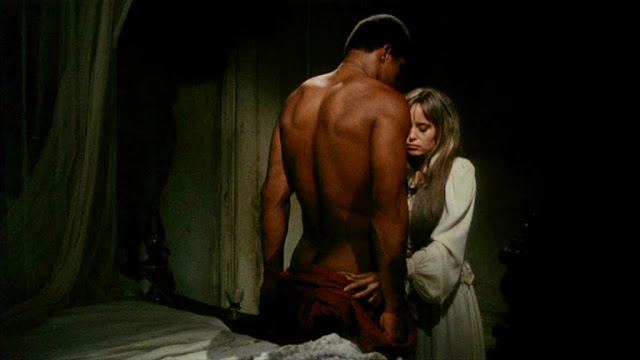
Mandingo
(1975)

RATING:80%
FORMAT:DVD


Fine film about the essential degeneracy of White culture, especially as regards their sex and money fixations.

Everyone here has their price; leaving no room for love or friendship or trust. The essential metaphor here is of a stud farm, where the only two purposes of sex are breeding and/or relief for both Blacks and Whites.

Uppity Whites parade as the genetic superiors of Blacks to conceal the deep-seated sexual insecurities caused by the fact that White supremacy means not being able to choose one’s true love: Arranged marriage being the dominant, but denied, form of legalized sexual relations among White Christians.

The White inability to see others, and each other, as individuals is well in evidence in their desperate drive to categorize human beings into pigeonholes that they cannot be shown to pre-fit, particularly as regards inferior and superior. This essential fact of White culture creates a dramatic problem that is implied - but only partly explored - in that the White characters are aspects of groupthink, not individuals in themselves, although we see some Whites struggling to achieve an individuality denied them by their culture’s emotionally repressive social imperatives.

One of the things that’s most disturbing about the film is the depiction of the consequences of slavery, racism and hypocrisy of Wwhites, how it warps son, Perry KING’s natural tenderness towards Brenda SYKES into a horrifying insecure paranoia that evolves into aberrantly exaggerated jealousy and sexually-motivated violence. And poor Susan GEORGE’s character is driven totally mad by her husband’s neglect and jealousy and the seemingly-contradictory tender erotic ministrations of slave, Ken NORTON.

The fragility of a White culture based on a genetic fallacy is implied in the fact Whites clearly recognize the humanity of Blacks - hence their fear of slave rebellions - while trying to deny the meaning of such rebellions (the human desire to be free) in the severity of the response to such drapetomania. This is also suggested by the Southern Gothic look (but not feel) of the interior scenes in their suggestion of wealthy emptiness and loveless satiation.

Here, the crime is its own punishment. Why would Whites create a culture so debased that they can achieve no personal satisfaction from it other than by debasing the bodies of others and, in the process, their own, in a desperate attempt – like the sadistic child pulling off the wings of flies – to achieve psychological fulfillment through physical violence? For Mandingo is a film about bodies: Bodies as commodities, bodies as skin color, bodies as objects and subjects of desire, bodies as instruments and recipients of violence. The characters here are limited to only understanding themselves as bodies: Doomed to be forever wanting, and never getting, more. The jarring tenderness of the scenes of miscegenation are complex and intense without being exploitive. The characters are attempting to escape their stifling social order (while tempting the viewer to do likewise) as the bodies of the four leads - Perry King, Brenda Sykes, Susan George and (especially) Ken Norton are eroticised by the camera and served up before the viewer as icons of unfettered sexuality and joyful celebration; ironically presided over by the decaying body of James Mason’s aging patriarch. They fail because their relationship are literally and metaphorically only skin-deep, so steeped in moral corruption are they – like the man who thinks sitting in a room full of spiders will cure him of arachnophobia.

The damned-if-you-do; damned-if-you-don’t mentality imposed on everyone by Whites is well-presented, yet the all-important justification for the Black Holocaust is entirely absent; making it difficult not to see the modern-day parallels to the White behavior displayed here since the attitudes shown are devoid of historical context and thus still relevant.

The real achievement of this film is the matter-of-factness of the cruelty and its casual and normalized nature in the minds of Whites who had also come to see each other as cattle in their breeding/marriage customs. As a description of a descent into a White hell, only a movie like Salo beats it. Unlike, the US tv-series Roots or Holocaust, there is no attempt to deny the basic hypocrisy (eg, White women are sluts if they enjoy sex) and schizophrenia (eg, Blacks are labeled inferior yet feared) of Whites nor to suggest that White supremacy is somehow unusual or deviant from White norms. Lacking melodramatic tricks, the accurate and historical facts of the matter are clearly laid out in fictional form to emphasize the fact that while White behavior changes, their attitudes do not.

A brilliant antidote to the attempt to hide the truth that is Gone with the Wind (although inferior to The Chant of Jimmie Blacksmith) and an excellent example of one of the many skeletons that Whites would prefer were left in the closet of their history. Like The Godfather, there is no way that this movie could be anything other than nasty and brutish in its content. Moreover, the White world is locked into a spiral that can only end in self-annihilation, yet is actually cathartic in portraying something against which everything else seems an improvement.


Copyright © 2012 Frank TALKER. Permission granted to reproduce and distribute it in any format; provided that mention of the author’s Weblog (http://protectingthehated.blogspot.com/) is included: E-mail notification requested. All other rights reserved.

Tuesday, 2 October 2012

Amazing Grace
(2007)

RATING:40%
FORMAT:DVD


Usual White supremacist nonsense about how abolishing racial slavery was an act of godliness, yet which never explains why the institution - and the racism supporting it - was established in the first place.

An incomplete history that leaves White culture unexamined, as if racial slavery were somehow a foreign imposition or disease that simply had to be cured, rather than an endemic part of the culture that helped fund the Industrial Revolution and the British Empire.

Inevitably, those who benefit from White supremacy today (Whites) are hardly likely to fully investigate the basis of their culture nor the present-day benefits that accrue to them from such supremacy (Institutional Racism).

The lowest estimates for the number of slaves forcibly migrated to the Americas are used in a vain attempt to minimize the scale of the Black Holocaust. As if this somehow minimizes guilt - guilt being seen as somehow a quantity rather than a quality. This is similar to Holocaust deniers disputing that six millions Jews were murdered.

The claim is made that racial slavery was accepted by most people as if even the slaves thought the same. But then White films like this never consider the victims as truly human - only the victimizers - the latter of whom are seen as misguided rather than volitionally evil. Compare this with the treatment of the Jewish holocaust, where the victimizers are always seen as willfully bad.

Whites here see Blacks as essentially passive; hence, the fact that slave rebellions are barely mentioned nor actively supported. Whites see Whites who speak out against slavery as brave, but not the Blacks who risk their lives to fight it. The present-day legacy of slavery (White supremacy) is still with us and is likely to remain so since old habits die hard - as movies like this attest.

There is no consideration of the short-lived economic benefits of racial slavery and that its abolition was a long-term economic advantage to Whites, since it rendered Whites more employable. Beforehand Whites experienced more unemployment because slaves do not need to be paid and are thus, in the long run, cheaper. There is also no mention of the economic fact that Prime Minister Pitt wanted slavery abolished because it was becoming less economically beneficial to the British Empire and because it would hurt the French Empire, whose slave colonies were far more productive. With Whites, the only constancy is hypocrisy.

There is no talk of why supposedly-loving Christians approved of such an unloving trade.

There is little recognition of the fact that Whites treat the White poor as little better than slaves. Wilberforce himself was a member of a secret committee investigating and repressing lower-class discontent in 1817; while opposing feminine anti-slavery associations; making this movie something of a hagiography, to say the least.

Whites discussing human rights is always nothing more than a parlor game in which human suffering is viewed only in the abstract - as here. The schadenfreude is self-evident and suggests racial slavery and abolitionism are two sides of the same coin. The brutality of slavery is simply a recognition of its economic fragility as a practice since it requires the use of expensive force to maintain it.

There is no consideration of the fact that any majoritarian democratic system will always legalize evil so long as a majority supports it; resulting in the moral compromise of gradual abolition in order to avoid slave as well as slave-master revolt - even though revolution is the only way to avoid such ethical compromise.

There is no consideration of the fact that the racism justifying slavery was not being abolished since it was also used to justify the British Empire. After so-called Emancipation in 1833, slaves could not own land nor vote, so the word Emancipation is clearly a misnomer.

Unsurprisingly, the film makes no comparison between the White Abolitionist horror of racial slavery with their fear of Blacks as people. The former is celebrated while the latter is resolutely ignored.

A perfect example of the narcissism pervading all White anti-racism; perfectly mirroring the self-regard of the White supremacist. Impossible to imagine any White more committed to the abolition of racial slavery than a Black yet, again, Blacks feature here mostly as passive victims - as if Whites believe the sufferings of Whites to abolish slavery were in any way comparable to the sufferings of slaves. As if Helen Suzman were the architect of the fall of Apartheid and not Nelson Mandela. As if the execution of Colonel Von Stauffenberg was somehow more important than the deaths of six millions Jews.

Somehow Whites believe only they can change the world for the better - saviors made in their own image - in a world they have made bad by their own actions; eg, Apartheid, Jim Crow, the Third Reich, the British Empire, etc. The mental conflict inside Whites as to the inconsistency between thought, word and deed on show here reveals a love of unearned privilege at permanent war with feelings of guilt and shame. As eerie a critique of White supremacy as one could possibly imagine; that ends up supporting it by supporting the abolition of racial slavery but not the racist British Empire: Abolishing the effect but not the cause.

As weak a critique of racial slavery as the film Amistad despite the exceptional quality of the acting talent and the high technical quality of the production

A film about John Newton (the composer of the eponymous song) would have made for a far more satisfying work, but that would have confronted a White audience with a crisis of conscience, regarding Negrophobia being the basis of their culture, that they still grapple with today. But this film evades all of this by pretending racial slavery has nothing to do with racism; thereby avoiding White blushes. Whites today still clearly have their moral priorities reversed and their ethical compass pointing in the wrong direction. A movie as White supremacist as the historical figures it denounces.


Copyright © 2012 Frank TALKER. Permission granted to reproduce and distribute it in any format; provided that mention of the author’s Weblog (http://protectingthehated.blogspot.com/) is included: E-mail notification requested. All other rights reserved.